
Lowering your gaze, Apni Nazro ki Hifazat Kare:

In our wedding ceremonies and parties and even in some Islamic events, there is heavy free-mixing between brothers and sisters. Often the chairs of males and females are arranged facing each other, knowing that about 90 percent of our sisters do not wear proper Islamic hijab. Perfume, makeuptight-fitting clothes and much more is always around. It is often noticeable to see males and females peeking glances at each other from the opposite ends of the hall. A big curtain is not my intention, but atleast- atleast a big and befitting Islamic manners is.

It’s not just about our weddings, it’s also our schools, colleges, offices, and marketplaces.

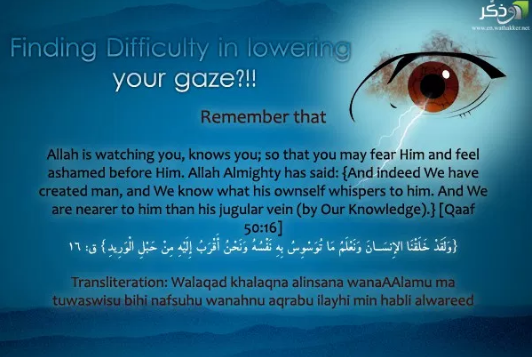
We should condition our minds to bring the verses of Surah Nur in front of our eyes during any tempting situations and imagine that Allah is speaking to us directly 

“Say to the believing, men that they should lower their gaze and guard their modesty. O, you believers! Turn you all together towards Allah that you may attain success” (24:30-31)

An Islamic idiom says, “Anything that leads to haram is haram in itself.” To do a pious deed is a reward; to avoid a sin is a reward too. 

Also, remind yourself of Allah’s (thawab) forgiveness and reward for those who lower their gaze in fear and obedience of Him, as the Prophet (peace and blessing of Allah be upon him) said, as narrated by Ahmad and Al Tabarany,
Whoever (Muslim) looks at the beauties of a woman, then lowers his gaze, Allah will reward him with an act of worship that he feels its sweetness in his heart.

Does lowering the gaze have any benefits to the human health?

Scientific research and studies proved that repeated desirous looking at the opposite sex, and the ensuing need to fulfill the suppressed and unfulfilled desires, lead to many problems as serious as productive system diseases, such as the cognition of prostate, the sexual inability, or total infertility.

One of prominent Islamic Author Yasmeen Mojahed somewhere says, ‘Lowering your gaze is such a comprehensive protection. And it doesn't just mean lowering your gaze from what is inappropriate. Also lower your gaze from what doesn't concern you, from the faults and private matters of others’.

Let us contemplate and consider all the above humble pieces of advice and constantly make the supplication, 

“O Allah help us control our sensual desires until we get married, and even after we marry, let our desires be only towards our spouses.”



Source of some texts: 
https://www.muslimmarriageguide.com/your-eyes-the-beloved-things-lower-your-gaze/
Images source: Google.com images

Compiled by: Maaz Mohammed A.Q
Bangalore, India

Popular posts from this blog

Read the articles in the light of Quran and Hadith- related to Prophet Mohammed (s.a.w), Taqwa, Tauheed, parents, children, family life etc (Links 2)

- Click the heading which you want to read more: a.  Understanding Islam b.  Quran and Hadith c.  Tauheed d.  Love towards Prophet Mohammed (s.a.w) e.  Teachings of Prophet (s.a.w) f.  Duas g.  Taqwa h.  Child is an innocent gift i.  Education j.  Respect towards each other k.  Respect your parents l.  An attitude m.  Family n.  Istigfar o.  Learning Quran p.  Ramzan q.  Sadqa r.  Dawat o Tableeg

Some of the traditional methods of raising children in Tarim (Yemen):

*Raising children* Some of the traditional methods of raising children in Tarim (Yemen). This is really beautiful. Women expecting children would ensure every morsel going into their mouths was halal. Breastfeeding mothers would repeatedly recite Ayah al-Kursi, Surah al-Falaq, Surah al-Nas and du'as of protection over their babies. When a child first began to speak it would be taught to say: رَضِيتُ بِاللهِ رَبّاً، وبِالإِسْلامِ دِيناً، Ùˆ بسيِّدِÙ†َا Ù…ُØ­َÙ…َّدٍ صلى الله عليه وسلم Ù†َبِÙŠَّاً ورَسُولاً ‘I am content with Allah as my Lord, with Islam as my religion, and with our Master Muhammad ï·º as my Prophet and Messenger.’ Parents would teach their children the importance of making good intentions and what intentions to make just as they would teach them how to recite Surat al-Fatiha. Parents would teach their children to call upon Allah in every situation. If a child asked for something, his parents would tell him to perform wudu, pray two rak'ats and then ask Allah to fulfil his...

How Allah explained Qiyamat through the example of locust, in reality this is seen in India. Astonishing.

See this video 1, what Allah says about Locust to explain about Qiyamat (Resurrection). Video 2 to 6: The rest of the videos of Locust captured real in India. Video- 1 What is locust? Locusts  are a collection of certain species of short-horned grasshoppers in the family Acrididae that have a swarming phase. These insects are usually solitary, but under certain circumstances they become more abundant and change their behaviour and habits, becoming gregarious (Wikipedia). Video- 2 Video- 3 Video- 4 Video- 5 Video- 6 Click to see the News coverage on locust in India: Source:  a.  The videos are collected through WhatsApp Message, and arranged in sequence. B. The first video is from 'One path'.

The Azan, or Islamic call to prayer- Details:

 - The Azan, or Islamic call to prayer, is a beautiful and sacred tradition in Islam. Here are the words to the Azan: # Azan 1. *Allahu Akbar* (4 times): Allah is the greatest. 2. *Ashhadu an la ilaha illallah* (2 times): I bear witness that there is no deity except Allah. 3. *Ashhadu anna Muhammadan rasulullah* (2 times): I bear witness that Muhammad is the Messenger of Allah. 4. *Hayya 'ala al-salah* (2 times): Come to prayer. 5. *Hayya 'ala al-falah* (2 times): Come to success. 6. *Qad qamat al-salah* (2 times): Prayer has begun. 7. *Allahu Akbar* (1 time): Allah is the greatest. # Du'a after Azan After the Azan, it is recommended to recite the following Du'a: "Alahumma rabba hadhihi ad-da'wat al-tammah, wa al-salat al-qaimah, ati Muhammadan al-wasilata wa al-fadhilata, wa ab'athu maqamam mahmudan aladhi wa'adtahu, innaka la tukhlif al-mi'ad." "O Allah, Lord of this perfect call and the established prayer, grant Muhammad the means and t...

An annual conference for education development (18th Conference):

 * 18th Annual Millat Conference (by MFERD)* #* Perform to Potential*# - Building Holistic Education Systems Dear Brother/Sister, Assalamu Alaikum All praise is to the Almighty Lord who created us and bestowed upon us the title of ‘Khalifa’, His vicegerent on earth. This implies that every individual has the ‘potential’ to perform the duties of the Almighty’s vicegerent. Unfortunately, due to several internal and external hindrances, man doesn’t live up to his potential. Similar is the case of our institutions. In the present world scenario, firmly anchoring and strengthening our educational institutions is of prime importance. It is probably the only way to create a collectively contributing ummah, that can positively influence the future of societies and countries. A handful of schools providing holistic education can significantly change the outlook of an entire city. Such is the potential of educational institutions. But the challenge lies in developing systems and practices (a...

ADHKARS BEFORE SLEEPING:

1. 🍬MAKE *WADHU*               🌟🌟🌟🌟🌟 2.🍬DUST OFF YOUR *BED*              🌟🌟🌟🌟🌟 3.🍬RECITE        *SURAH MULK*                    AND            *SURAH SAJDAH*                      🌟🌟🌟🌟🌟 4.🍬 RECITE         *SURAH IKHLAS*         *SURAH FALAQ*         *SURAH NAS*   When retiring to his bed every night, the Prophet (saws) would hold his...

My Tryst with Urdu and Journey so far:

 - By: Iqbal Sattar Dear friend. I was educated up to 3rd standard in Dharwad in Government Urdu School. Our Teacher with white pagadi and hanging back portion was so nice. My father was an Education officer in Dharwad. He established many Urdu Schools, in Dharwad, Bijapur, Belgaum and Karwar. He used his approach to Urdu Schools in villages for community outreach. I completed my 7th in Belgaum Government Urdu School and SSC ie XIth in Islamiya High School Camp Belgaum. These 11 years of Urdu medium strengthen my love for Education. The teachers in those days were devoted. Our Headmasters and principal Late Adam Jamadar, were great personalities.  Library, newspaper, reading books, discussion, allocution competitions, sports, science exhibition, and Drama competition were part of Education. We learnt good English, Persian, Kannada and Marathi along with Urdu. The interaction with teachers was wonderful. My principal had called me in his office and corrected my Aswersheet for 3...

Quran Quiz:

1) What is the meaning of            the word "Qur'an" ?     A) That which is Read. 2) Where was the Qur'an      revealed first ?     A) In the cave of Hira           (Makkah) 3) On which night was the       Qur'an first revealed ?      A) Lailatul-Qadr (Night of       the Power) 4) Who revealed the Qur'an? A) Allah revealed the Qur'an 5) Through whom was the      Qur'an revealed?     A) Through Angel      Jibraeel (Alaihis-Salaam) 6) To whom was the Qur'an       revealed?     A) To the last Prophet,        Muhammed (Sallahu       Alaihi Wasallam). 7) Who took the. responsi_      _bilit...

Islam is overall a religion of perseverance and tolerance. In short a religion of patience:

-  July 29 2021 (The original speech was in urdu, after that it is translated into English text by Mohsin sir) Surah Al kahf. Meaning of patience explained:  *By famous scholar of Islam Ibn Ul Qayyim in his book "Patience and Gratitude."*  "It means stronger common sense and religious motives."  *Patience has a different role in different aspects.*  * When controlling sexual desires it's called honor (waqaar). *When restraining greed it's self control(tahammul) *When used in anger management it's forbearance (bardaashth). *When refraining from haste and hurry it's gracefulness (Shaistaa). *When refraining from running away it's courage (bahaduri). *When avoiding revenge/retaliation it's forgiveness (Maafi). *When refraining from stinginess (kanjoosi) it's generosity (Sakhawath). Islam is overall a religion of perseverance and tolerance. In short a religion of patience. Being created with a mixture of fire, water, mud and air, certain fea...

Love towards my Kind Teacher (S.A.W):

Love is when Bilal (Radhiallahu 'anhu) stopped giving the adhan after the death of the Prophet (sallallahu alaihi wasallam) Love is Bilal leaving Madina after the Prophet’s (sallallahu alaihi wasallam) death because everything reminded him of his beloved Love is Bilal seeing the Prophet (sallallahu alaihi wasallam) in a dream telling him, "what is with this dryness/distance oh Bilal?" when a long time had elapsed since he visited the Prophet's (sallallahu alaihi wasallam) grave, prompting Bilal to head to Madinah upon waking Love is Bilal arriving in Madinah in the middle of the night and Hasan and Hussain (Radhiallahu 'anhum) finding him at the maqam of the Prophet (sallallahu alaihi wasallam) crying and Hasan and Hussain insisting that he give the adhan for Fajr. People came rushing to the masjid: weeping and anguished - reminded of their days with the Prophet (sallallahu alaihi wasallam) Love is Bilal…when Umar ibn al Khattab (Radhiallahu 'anhu) asked h...